
Annual allowance
At a glance
The annual allowance limits how much your pension (from all pension schemes) can grow each year before tax charges might apply.
For the 2026/27 tax year this is £60,000.
You are in the
2015 scheme

Exceeding the allowance
Why does this matter?
If you exceed the annual allowance, you may receive a tax charge.
In the police pension scheme, if you exceed the annual allowance, your administrator will send you a pension saving statement each year letting you know the amount of pension you have built up.
Find out more in the government website.
How does it add up?
Calculating your pension input amount
The amount your pension has grown in a year is known as your pension input amount. This amount is compared to the annual allowance to see if you have exceeded the limit which may result in a tax charge. To calculate how much your pension from the police pension scheme has grown in a year (your pension input amount), you use the following formula:
Value of the benefits built up at the end of the year
16
Value of the benefits built up at the start of the year
Value of the benefits built up at the end of the year
1The value of any lump sum does not include lump sums that are commuted (where you exchange the value of your pension for a lump sum). So, in the case of the police pension scheme, the lump sum value would only apply to members of the 2006 scheme.
Example: Calculating 2015 pension input amount
Meet James, he has been a member of the 2015 police pension scheme for 5 years. For the 2025 - 2026 tax year James’s pension input amount is calculated as follows:
Factors
Annual pension at start of year
£8,000
Lump sum at start of year
£0
Annual pension at end of year
£10,000
Lump sum at end of year
£0
CPI
1.7%
Calculate benefits at the start and end of year
Value of benefits at the end of the year
£10,000
LESS
Value of benefits at the beginning of the year
£8,136
Compare start and end of year values
£1,864
Multiply by 16 to find the pension input amount
£29,824
Compare to the annual allowance
Pension input amount
£29,824Annual allowance
£60,000When comparing James’s pension input amount to the annual allowance, we can see that James doesn’t not exceed it e.g. £29,824 pension input amount V an annual allowance of £60,000. So there would be no tax charge for James.
Scheme pays options
If you exceed the annual allowance
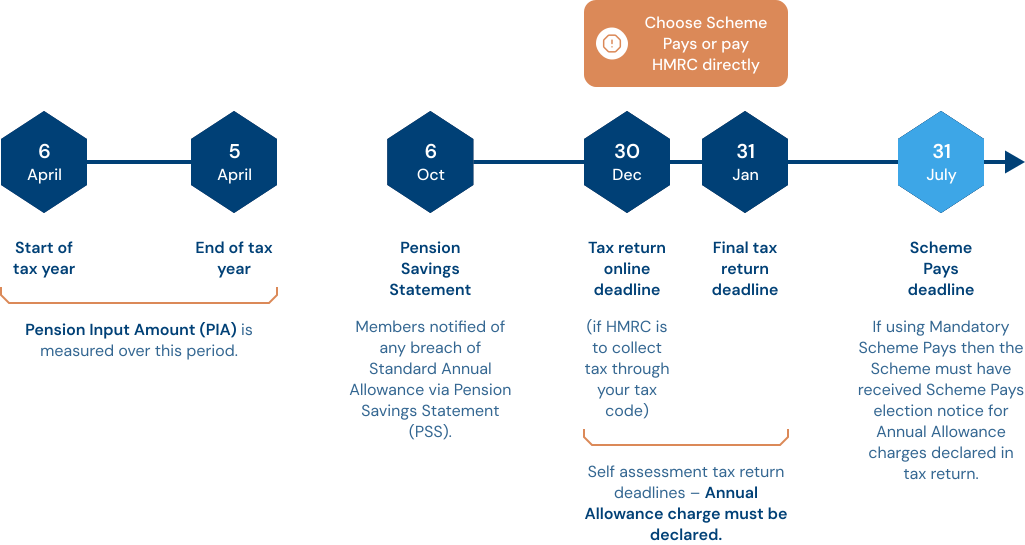
You will receive a pension saving statement by 6 October each year if your administrator calculates that you have exceeded the annual allowance for your police pension.
Tax charges
If you exceed the annual allowance, the amount that you have exceeded it by is taxable at the same rate as your income. You can pay this charge through your tax return or using scheme pays.
Example
If you have exceeded your annual allowance by £10,000 and you have a marginal rate of income tax of 20%, then the tax due would be: £10,000 × 20% = £2,000
Scheme pays
If you exceed the annual allowance, you can ask the police pension scheme to pay the tax charge for you. This will be a permanent deduction from your pension when you start to take your benefits.
In the police pension scheme, there are two types of scheme pays.
When it can be used
- Annual allowance charge exceeds £2,000
- Pension input amount is bigger than your annual allowance

Unused allowances
Carry forward
If you haven’t used your full annual allowance in the previous three years, you can carry forward unused elements, this can help reduce of eliminate any annual allowance tax charge.
- You can carry forward any unused allowance from any of the three previous tax years
- You must use allowances in a set order, use the current year’s allowance first, then use the oldest of the three years, after that move forward year by year
- You can’t save more into your pension than you earn in the same tax year
Carry forward example
Jean hasn’t always used her full annual allowance:
| Tax year | Annual allowance | Pension input amount | Unused allowance |
|---|---|---|---|
| 2025/26 | £60,000 | £80,000 | £0 |
| 2024/25 | £60,000 | £40,000 | £20,000 |
| 2023/24 | £60,000 | £35,000 | £25,000 |
| 2022/23 | £40,000 | £30,000 | £10,000 |
For the 2025/26 tax year, Jean has an annual allowance of £60,000 PLUS the unused allowance (carry forward) from the previous three years (£20,000 + £25,000 + £10,000).
This makes her annual allowance £115,000 (£60,000 + £20,000 + £25,000 + £10,000).
As her pension input amount is £80,000 she is within her annual allowance. (£115,000 - £80,000).
She also has some carry forward remaining to use in future years.
High earners
Tapered annual allowance
If you are a high earner, your annual allowance is reduced. The amount it is reduced by depends on your income. This is known as a tapered annual allowance. Generally, the reduction starts for people earning over £200,000 a year, or who earn £200,000 and have saved £60,000 or more into their pension for the tax year.
Full details for how to calculate the impact on you can be found on the government website.