
When can you retire?
At a glance
When you retire your pension is paid by your police authority. The amount you receive will depend on the age you select to retire and how much pension you exchange for a lump sum (known as commutation).
You are in the
2015 scheme
Summary of your options
Retirement flowchart
Do you have benefits in one of the legacy schemes?
Age 60
Normal pension age
This is the age you can retire and take your pension in full.
Active members
For active members – those members who are contributing to the scheme until they retire – normal pension age is 60.
Deferred members
If you have left your benefits in the police pension scheme i.e. they have been deferred, you can take your pension from your state pension age.
State pension age varies depending on when you were born. You can find out your state pension age on the government website.
Qualifying service
You must have two years of qualifying service to be able to take your pension. This includes:
- Two years of service within the 2015 scheme, without a break
- Transferred in service from other employment
- Service within the 1987 and 2006 schemes
Find out what happens to your pension if you have less than two years’ qualifying service in the opting out section.
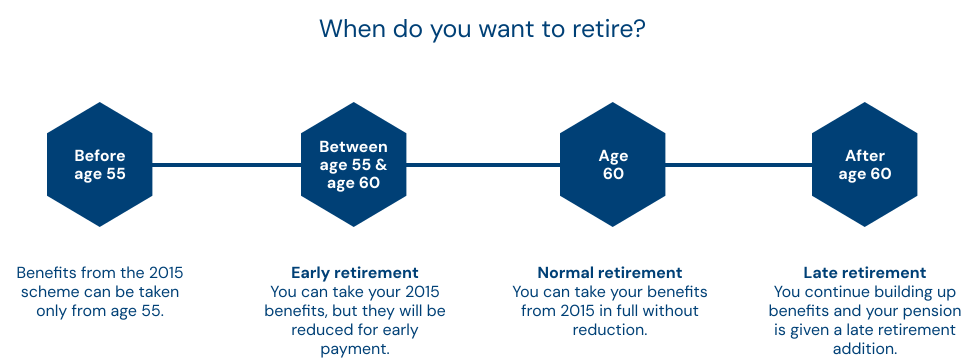
From age 55
Early
The earliest age you can access your pension is age 55.
If you choose to access your pension before your normal pension age it would be reduced because it will be paid for longer.
The amount it is reduced by is calculated using an ‘early retirement factor’ and depends on the age you choose to retire. The tables at the end of this section show the early retirement factors for active and deferred members.
Active members - how much your pension may be reduced by
Select the age you are planning to retire, or the years and months early, to find out how much your pension may be reduced.
OR
Example: early retirement from the 2015 scheme
David wants to take his pension at age 56, rather than waiting for his normal pension age. Using the active member early retirement factors, David can see that the early retirement reduction would be 16.70%
Age
56
Type of member
Active
Pension accrued at age 56
£30,000
Cash lump sum taken
£0
This means that his pension would be reduced by = £5,010 (£30,000 X 16.70%)
He can start taking his pension from age 56 and receive £24,990 a year.
Or, if he continues working until age 60, he would accrue more pension over the next four years and there would be no reduction applied to his pension when it becomes payable at age 60.
Active members - early retirement factors
Early retirement reductions are based on the number of years and months you are taking your benefits before the normal pension age of 60.
| Age at retirement | Years early | Percentage reduction (%) |
| 55 years | 5 | 20.20% |
| 56 years | 4 | 16.70% |
| 57 years | 3 | 13.00% |
| 58 years | 2 | 9.00% |
| 59 years | 1 | 4.70% |
| 60 years | 0 | 0.00% |
Find out the full breakdown of early retirement factors for active members in the factors table in the resources section.
Deferred members - early retirement factors
Early retirement reductions are based on the number of years and months you are taking your benefits before the deferred normal pension age of your state pension age.
| Years early | Percentage reduction (%) |
| 13 | 47.00% |
| 12 | 44.80% |
| 11 | 42.40% |
| 10 | 39.90% |
| 9 | 37.20% |
| 8 | 34.20% |
| 7 | 31.10% |
| 6 | 27.70% |
| 5 | 24.00% |
| 4 | 20.00% |
| 3 | 15.70% |
| 2 | 10.90% |
| 1 | 5.70% |
| 0 | 0.00% |
Find out the full breakdown of early retirement factors for deferred members in the factors table in the resources area.
A choice
Option to buy out early retirement reduction
If you decide to retire early, your pension would be reduced as it is being paid for longer. However, you can select to ‘buy out’ the reduction in pension so that you receive your pension in full.
The amount that you would need to pay would be determined by your police authority. You would need to make a one-off payment to cover the amount of the reduction that you want to buy out.
Calculating the cost to ‘buy out’ the reduction
The amount you wish to buy out is multiplied by a factor, based on your age in complete months at the date you retire. This reduces the closer you are to the normal pension age.
This is calculated as:
buy out factor
You can see a full breakdown of the factors used to buy out an early retirement reduction in the resources section.
After age 60
Late
You can remain a member of the scheme until you reach age 75. You do not have to take your pension at age 60.
If you remain in the scheme you would continue to build up benefits for each year that you are a member. You would also get a ‘late retirement addition’ which is an additional payment to boost your pension.
If there is less than a year between your normal retirement age and the age you select to take your pension late, the late retirement addition applied would be different. Specific examples can be provided if this applies to you.
Example - late retirement for an active member
Meera is an active member in the police pension scheme.
Her pension is worth £10,000 a year.
She also previously made some added pension payments which means that she has some added pension which is worth £1,500 a year.
As Meera was 61 on 1 April at the start of the scheme year, her pension and added pension need to be increased by the age addition.
Using the factors from the table, Meera’s benefits would be increased by:
Pension
0.035
1
This means her total pension would be £10,350 a year.
Added pension
0.048
1
This means her total added pension would be £1,572 a year.
Total (pension and added pension)
£1,572
By working for 1 full year past her normal pension age of 60, her total annual pension has been increased by £421.
See the full set of late retirement factors for deferred members who take their benefits after state pension age in the resources section.
Your options
Retiring and returning to work
You can retire from the police pension scheme and then return to work. If your pension is going to be paid immediately, and you then return to work as a police officer, you must be retired for at least 28 days before returning to work.
If you were to return sooner, your pension would be stopped and you would have to pay back any amounts paid to you including any lump sum.
You cannot select to start to receive your pension whilst continuing to work.
In the 2006 and 1987 sections of the police pension scheme there are rules preventing members from retiring and then returning to work and receiving both a pension and a salary. This is known as abatement. These rules do not apply to the 2015 scheme.